

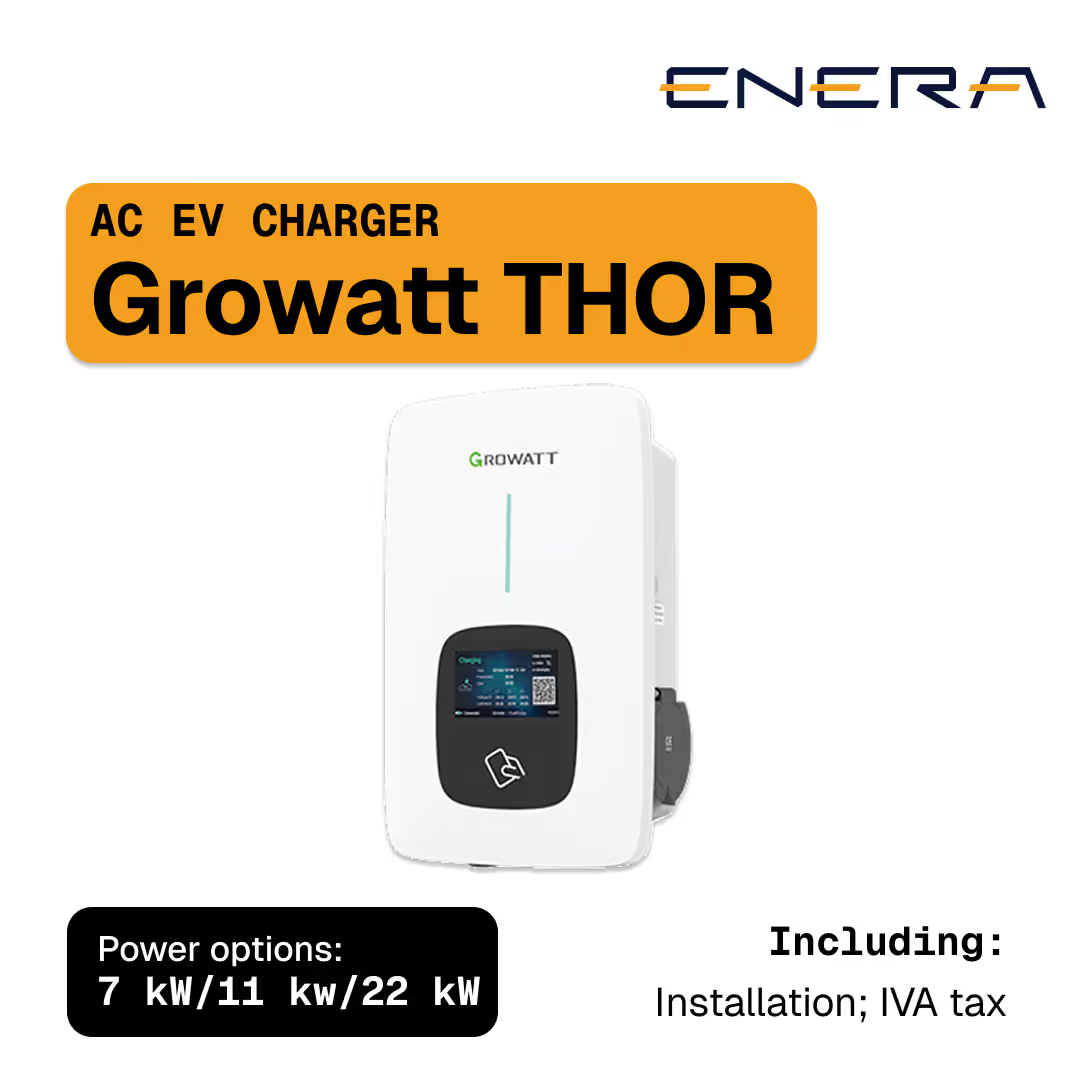
Home EV charging in Spain: choosing and installing a wallbox
A wallbox is a fixed charging point wired into your home installation. It replaces the emergency cable that came with the car, which draws around 2.3 kW from a domestic socket and needs most of a day and a night to fill a modern battery — and which was never designed to be used every day.
Two things decide which wallbox you can have: whether your house is supplied single-phase or three-phase, and how much power your contract allows you to draw. Everything else — brand, app, cable length — is a preference. These two are physics and paperwork.
This category currently lists 3 wallboxes from 7 to 22 kW, starting at 1319 € including VAT — supplied and installed.
Single-phase or three-phase, and what your contracted power allows
Most Spanish homes are supplied single-phase at 230 V. On that supply a 7 kW charger draws 32 A on the one phase available, which is more than many domestic contracts are rated for — typical residential contracted power sits well below that once the rest of the house is counted. In practice you either raise your potencia contratada, or you schedule charging for the hours when the rest of the house is asleep, or both.
Three-phase supplies at 400 V change the arithmetic. An 11 kW charger spreads its load as 16 A per phase and a 22 kW charger as 32 A per phase, so a three-phase house can charge two or three times faster without any single conductor carrying more current than a 7 kW single-phase point would.
This is the first thing we check, before anything is quoted. If your supply cannot carry the charger you want, we say so — a wallbox that trips the main breaker every evening is not a solved problem.
Charging the car from your own solar
The THOR chargers we install run a PV-linkage mode: instead of pulling a fixed current, the charger follows the surplus your panels are producing after the house has taken what it needs, and modulates its own power up and down to match. On a sunny weekday that means the car fills on energy that would otherwise have gone to the grid.
You do not need a home battery for this. Surplus charging works directly off the array, which is one of the reasons a car is such a good match for solar in Spain — it is a large, flexible, daytime load.
Everything is controlled from the Growatt app: switch between fast, PV-linkage and off-peak modes, set schedules, cap the current, and review the charging history. Native integration with Growatt inverters is the practical advantage over a generic wallbox — the charger and the inverter are looking at the same production data.
Which THOR fits your house
The 7 kW THOR is the residential standard: single-phase, 32 A, and the right answer for the large majority of homes on this coast.
The 11 kW model needs a three-phase supply and 16 A per phase, and it makes sense when daily mileage is high enough that overnight charging time genuinely matters.
The 22 kW model is the fastest AC option and suits three-phase properties with very high mileage or more than one electric car. It is not for every home, and it needs a properly sized three-phase connection — we confirm that on site before we quote it.
All three share the same hardware: a Type 2 connector to IEC 62196-2, a 5 m cable on the plug version, IP65 so an outdoor wall or a carport pillar is fine, an operating range of −25 to +50 °C, Wi-Fi and Ethernet with optional 4G, OCPP 1.6, and a 3-year warranty.
What ENERA installs
A wallbox installation is an electrical job, not a bracket on a wall. We survey the existing installation and your contracted power, run a dedicated circuit from the board with its own protection, route and fix the cable, mount and commission the unit, and set up the app with you before we leave.
Where the installation needs certification by an authorised installer, that is part of the job and not an extra. If your board or your contracted power needs work first, you hear about it during the survey and it appears in the quote — never as a surprise on installation day.
We work in English, and the survey, the quote, the installation and the certificate all come from the same company.
What changes the price
The charger itself is the predictable part. What varies between two otherwise identical houses is the distance from the distribution board to where the car parks, whether that run is surface-mounted or has to be chased or ducted, whether the board has a free way and enough capacity, and whether the supply needs upgrading at all.
A garage directly under the board is a short job; a parking space at the far end of a plot, or a charger for an apartment in a shared garage, is a longer one. We measure the run on site rather than guessing it, so the quote you receive is the price you pay.