

Voltage stabilisers for solar homes on weak Spanish grids
If your lights dim when the pump starts, if your inverter keeps disconnecting and restarting for no obvious reason, or if appliances have failed years before they should have, the problem is usually not your equipment. It is the voltage arriving at your house.
A voltage stabiliser — an estabilizador de tensión — sits between the incoming supply and your installation and holds the output steady while the input wanders. It is one of the least glamorous products in this catalogue and one of the few that solves a problem you can measure in a week.
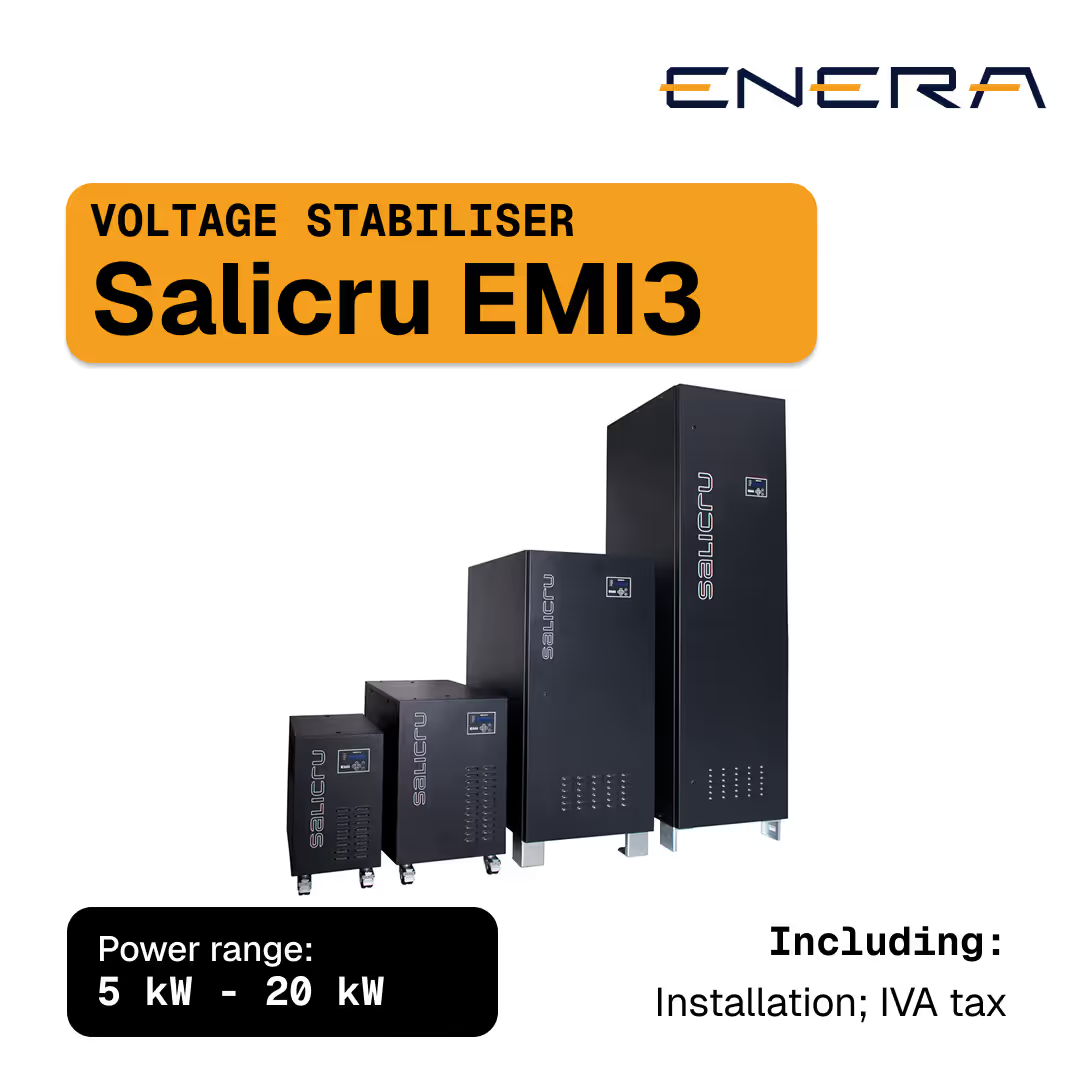
This category currently lists 6 stabilisers from 5 to 20 kVA, starting at 3395 € including VAT — supplied and installed.
Why homes on this coast need one
Spanish low-voltage supply is nominally 230 V single-phase or 400 V three-phase. What actually arrives at the end of a long rural spur, in an urbanisation built out further than the network was planned for, or on an island supply, can be a long way from that. Voltage sags when a neighbouring load starts and swells at night when the area goes quiet, and both extremes do damage.
Grid-connected inverters are required to disconnect when mains voltage leaves its permitted window. On a weak supply that is not a rare fault — it is a daily occurrence, and every disconnection is production you paid for and did not get. Motors suffer at the other end: fridges, pool pumps and air-conditioning compressors draw more current at low voltage and run hot, while electronics age fast on a supply that sits persistently high.
This is a Costa Blanca and rural-Spain problem far more than a city one. If you have moved from northern Europe and never had to think about mains voltage before, that is because your old grid was short, dense and stiff. This one often is not.
A stabiliser is not a UPS
The two get confused constantly, and they solve different problems.
A UPS contains a battery. When the supply fails it keeps a small load running for minutes so that nothing is lost. It does not economically cover a whole house, and it is not designed to run continuously against a supply that is merely wrong rather than absent.
A stabiliser has no battery and does nothing at all in a blackout. What it does is regulate continuously: it corrects the incoming voltage on the fly and delivers a steady output to everything downstream, at whole-house power levels, all day, every day. The units here hold output to ±1% and correct at up to 70 V per second.
Surge protection is a third, separate thing: it clamps fast transients from switching and lightning, and it does nothing about a supply that simply sits at 200 V all afternoon. The three are complementary, and a house on a bad grid often wants more than one of them.
Sizing in kVA
Size the stabiliser to everything that will pass through it, not just to your inverter. It is installed upstream of the inverter and the main distribution board, so the stabilised supply feeds the whole protected installation — inverter, pumps, air conditioning, kitchen and all.
The units here are rated 5, 7.5, 10, 15 and 20 kVA, quoted as kVA and kW alike because they are specified at unity power factor. For a single-phase home with a 5–6 kW inverter, 7.5 kVA is the usual answer; larger single-phase supplies with high connected load move up to 10 or 15 kVA.
Leave headroom. These units tolerate up to 200% overload for 20 seconds, which covers motor starting, but a stabiliser run permanently at its rating has nothing left for the surge. Efficiency is 96.5–97.5%, so the conversion loss is small — though the unit is in circuit continuously, which is another argument against buying more kVA than you need. Logging your actual voltage for a few days before sizing anything is worth the wait.
Single-phase or three-phase
The single-phase units — 5, 7.5, 10 and 15 kVA — work on 220/230/240 V supplies with an input window of 140–260 V and deliver 230 V at ±1%, adjustable between 1% and 5%.
The three-phase units — 15 and 20 kVA — work on 3×380/400/415 V supplies with an input window of 340–460 V and deliver 3×400 V to the same accuracy. A three-phase stabiliser regulates all three phases, which matters on properties where the load is spread across them and on agricultural sites with three-phase pumps.
The standard input tolerance is ±15%, extendable to ±30% on request. Outside its window a stabiliser can no longer guarantee its output and will protect itself instead, so if your supply collapses far below that range the answer is a different conversation — not a bigger stabiliser.
All of these units are rated IP20 and want a dry, ventilated indoor location. They are also heavy, from around 40 kg for the 5 kVA up to about 144 kg for the 20 kVA three-phase, so where they go is a decision made on site, not afterwards.
What ENERA installs
Every stabiliser in this category is a Salicru unit, with a 3-year warranty, a local LCD display and status LEDs, and an optional RS232 or SICRES communication slot if you want it monitored remotely.
We measure the supply where we can, size the unit against your inverter and your connected load, install it upstream of the main board, and commission it together with the solar installation so that the inverter sees a clean supply from the first day. If you already have solar from someone else and it keeps dropping out, this is one of the few problems where the diagnosis is quick and the fix is permanent.