A large share of the off-grid enquiries we get in English start the same way: someone has fallen for a house in the campo, and somewhere between the viewing and the notary it emerged that the property has no electricity connection — or that the quote to bring one in is a five-figure civil-engineering job. The estate agent said "you can just put solar on it". That is true, and it is also the beginning of a much longer conversation. This guide is that conversation, from the installer side.
First, establish which of two situations you are actually in
There is a real difference between a house with no supply point at all and a house that has a connection you would rather not use. Only the first one is an off-grid project. If there is a meter on the wall, going off-grid is a lifestyle decision, and an expensive one — we will talk you out of it below.
Get this settled before you exchange contracts, not after. Ask the seller for the last electricity bill and for the boletín — the electrical installation certificate — and ask the distribution company for a written connection quote for the plot. Two documents and one quote will tell you more about the real cost of that house than any amount of reading about batteries.
Why grid-tied usually wins where the grid exists
If you have a working supply, staying connected and installing self-consumption solar is almost always the better economics, and it is worth understanding exactly why. Connected to the grid, every kilowatt-hour you generate and do not use at that instant is exported and credited against your bill under Spain’s surplus-compensation scheme. Off-grid, that same kilowatt-hour does not exist: when the battery is full and nothing is drawing, the inverter simply curtails. In our own savings model, exported energy for an off-grid system is a hard zero, and the share of annual output that ever gets used is capped well below 100 % even with a large battery bank. Nobody selling boxes will tell you that, because it is the one number that makes an off-grid kit look worse than a grid-tied one.
So if you do have a supply point, price the grid-tied option first: the calculator takes your bill, and the grid-connected kits are the shorter, cheaper path. We would rather lose an off-grid sale than sell you independence you do not need.
When off-grid is genuinely the right answer
- There is no supply point and the connection is a building project. The nearest line is hundreds of metres away, across land you do not own, and the quote includes wayleaves. This is the ordinary case in the Spanish campo, and it is the one where an off-grid system is not a compromise but the sensible answer.
- The plot is rústico. Grid infrastructure follows development that pays for it. On a genuinely rural parcel there is often simply nothing to extend.
- A second building on the same finca. A casita, a workshop, a guest annexe or an irrigation store two hundred metres from the main house. Trenching a buried line out to it frequently costs more than giving it its own system.
- Pumping and irrigation. A borehole pump that only ever runs in daylight is the easiest off-grid case there is, because demand lines up with production and the battery can stay small.
The battery sizes the system — the panels do not
Retail kits are advertised in panel watts. On a real off-grid house the binding constraint is different: how many kilowatt-hours you need after dark, and for how many consecutive days without sun. An off-grid system is sized against the worst month, not the annual average, and mainland Spain’s December is a very different place from its July — same roof, same panels, roughly half the useful hours and cloudy days that arrive in runs.
So the three numbers that matter, before you look at any catalogue, are your daily consumption in kWh in the worst month, how many days of autonomy you want, and which loads you are willing to move to the middle of the day. That last one saves the most money: washing machine, dishwasher, pool pump and car charging can all be scheduled. The fridge and the lights cannot.
Every one of our off-grid kits ships with a 5 kWh lithium battery included — it is a real component of the kit, not an upsell added in the basket — and the bank is expanded from the product page itself, up to 45 kWh in the HOPE range. For a house lived in year-round, treat the included battery as the starting point rather than the answer. How capacity, depth of discharge and cycle life actually trade off is covered in the battery guide and on the battery pages in the shop.
Your inverter is sized by the well pump, not by the house
An off-grid inverter is not chosen by the average load of the house. It is chosen by the surge the largest motor demands at the instant it starts. A borehole pump, an air-conditioning compressor or a gate motor briefly draws several times its rated power. An inverter that would run the property happily for twelve hours a day will trip the moment the pump kicks in — and the owner concludes the kit was undersized, when the problem was the start-up surge.
That is why all five inverters we fit are purpose-built off-grid units — the Growatt SPF and SPE series — with an integrated MPPT charge controller and a generator input. The first means one box manages the array, the battery and the house loads. The second means a bad winter week does not leave you in the dark: the generator starts, charges the bank and shuts down again. In a permanently occupied campo house the generator does not disappear, it changes job — from being the power supply to being the insurance policy you use a handful of times a year.
One thing to know early: all five off-grid kits are single-phase. For a dwelling that is normal and correct. If the finca has three-phase machinery — a large irrigation head, a cold store, a working workshop — the project is a different one and needs discussing up front. What each supply type means is in the single-phase or three-phase guide.
Where the equipment lives, and the siting mistake that costs the most
The panels go out in the sun and cope with anything. The electronics do not. The HOPE battery included with our kits is rated IP20 and works between −20 and 55 °C — meaning indoors, dry and ventilated. It is not a cabinet to hang on a south-facing wall, and not something to put in a metal caseta that exceeds 55 °C inside on an August afternoon. On a campo property this almost always means setting aside a small technical room: a store, a pantry, a corner of the garage, ventilated and under cover.
Distance matters too, and rural plots make it easy to underestimate. The further the panels sit from the inverter, and the inverter from the battery, the heavier the cable has to be to avoid losing voltage on the way. When someone sends us a plot with "plenty of room" for the array a hundred and fifty metres from the house, the conversation starts with cabling, not with modules.
Paperwork: less than a grid-tied install, but not none
This is where the internet exaggerates in both directions. What is genuinely and structurally true: with no supply point there is no distribution company to register anything with, no switch to a self-consumption contract, and no surplus compensation, because there is no grid to export to. That entire half of the process — the half that takes weeks on a grid-tied job and is outside the installer’s control — disappears.
What does not disappear is the other half. An off-grid system is still a low-voltage electrical installation: it has to be built to the regulations and certified, and the town hall still has a say over the works, more so on rústico land or in a protected setting. The specific requirements vary by municipality and by autonomous community, so the honest answer is not a generic checklist in a blog post — it is checking your town hall before quoting. We do that, and the paperwork is included in the fixed kit price.
If an installer tells you an off-grid system means "no paperwork at all", they are not saving you effort. They are leaving you without the certificate you will be asked for the day you sell the house, apply for a grant, or try to insure it.
What our off-grid kits actually contain
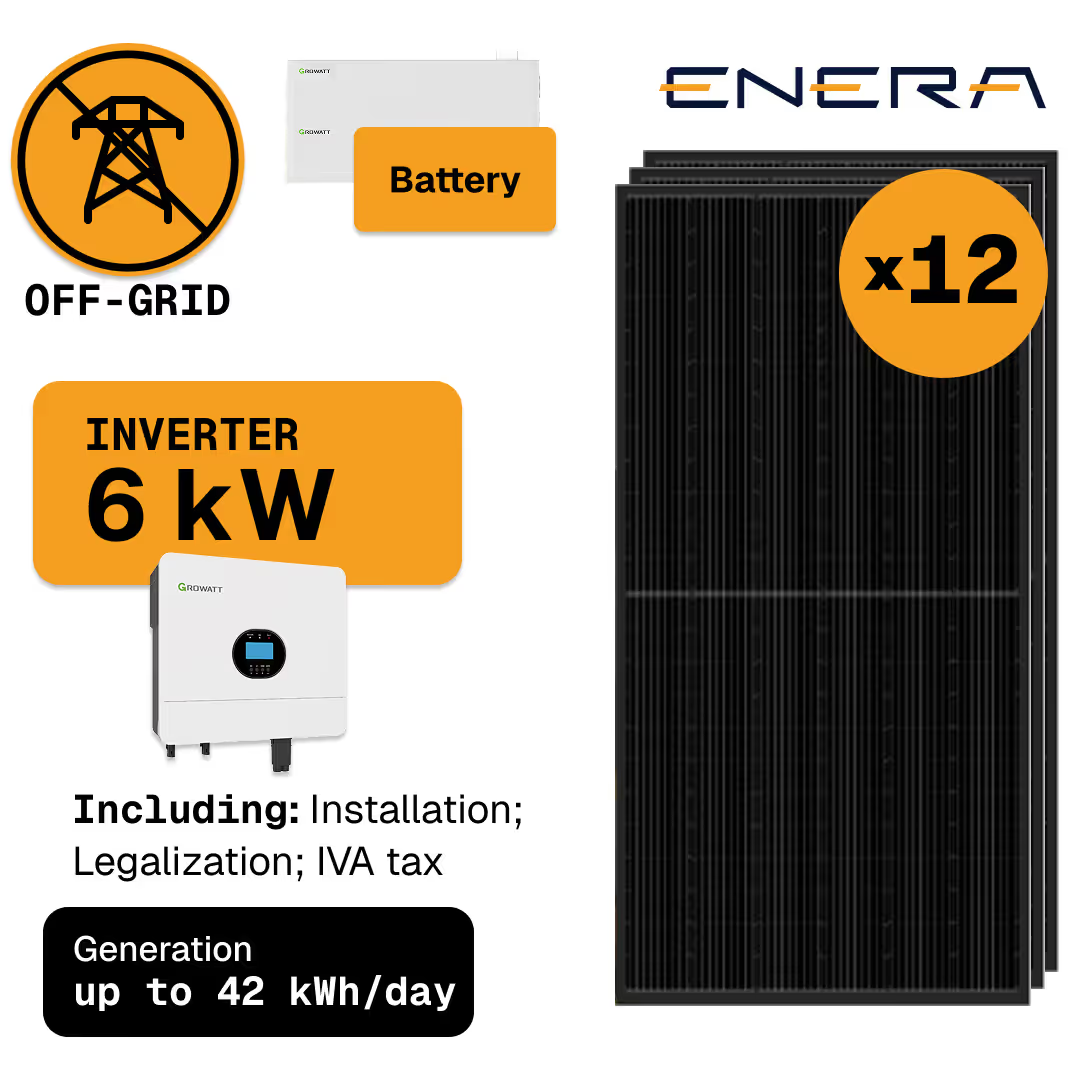
We build five off-grid systems: 3 kW, 6 kW, 8 kW, 10 kW and 12 kW. They share one architecture: Tensite 500 W TOPCon N-Type panels, a single-phase Growatt off-grid inverter with integrated MPPT and a generator input, and a 5 kWh HOPE lithium battery included as standard and expandable from the product page. Turnkey prices, with VAT and installation, live in the shop — they update themselves there, which is exactly why this guide carries no hand-typed euro figure.
And a warning about the arithmetic: off-grid savings are not measured against an electricity bill, because there is no bill. They are measured against what the same energy would cost from a diesel generator including fuel and servicing, or against a connection quote you have decided not to pay. That is a different comparison and it works for different reasons. Each kit page shows the usable share of production we are assuming; if you want to put your own consumption and fuel-cost numbers in, the tool is the configurator, not the bill calculator.
Where we work
We publish our installations anonymised: 583 as of 20 August 2026, of which 352 are photovoltaic and 231 solar hot water. That dataset separates PV from thermal but it does not separate grid-tied from off-grid, so you will not find a "we have done X off-grid installs" claim here. We do not publish it because we cannot show it, and a number you cannot show is worth nothing. What we can show is where we work and the real volume in each municipality:
- Torrevieja — 46 installations
- Finestrat — 44
- Orihuela — 39
- Altea — 27
- Calpe — 19
- Rojales — 13
- Alfaz del Pi — 13
- Moraira — 11
- Benissa — 4
Each municipal page carries the PVGIS irradiation figures for that district and the tax reductions we have read in its own ordinance. If your plot is not on the list, ask anyway — the Alicante campo, the Vega Baja and inland Murcia are ordinary destinations for us.
Where to start
To size an off-grid system we need three things, and the size of the roof is not one of them: your daily consumption in kWh, a list of the motors on the property with their ratings, and whether the house is lived in year-round or seasonally. Those decide the battery, and the battery decides everything else. You can build the system yourself in the configurator, or just describe the property to us via contact. If it turns out there is a connection fifty metres away, we will tell you, and the conversation moves to a different page.
Frequently asked questions
I am buying a Spanish campo house with no electricity — can solar really replace a connection?
Yes, and for a property with no supply point it is usually the only realistic option. The caveat is that it has to be designed around your actual consumption and the darkest month rather than bought by kilowatt rating. Before you commit to the purchase, get a written connection quote from the distribution company anyway: it is the number that tells you whether off-grid is your best option or simply your only one, and it is worth knowing which.
Does an off-grid installation in Spain need to be registered or certified?
It is still a low-voltage electrical installation, so it must be built to the regulations and certified as such, and the town hall keeps its say over the works — particularly on rústico land. What falls away compared with a grid-tied system is the entire grid side: no registration with the distributor, no self-consumption contract, no surplus compensation, because there is no supply point. Municipal requirements differ, so we check your town hall before quoting and the paperwork is part of the fixed price.
What happens to solar energy I generate but do not use?
It is lost. Once the battery is full and nothing is drawing, the inverter curtails the array. That is not a fault — it is the definition of being off-grid, since there is no network to export into and nothing to be credited for. It is also why an off-grid system is sized from measured consumption rather than optimism, and why shifting loads into the middle of the day is worth more here than on any grid-connected house.
Will an off-grid system run air conditioning and a well pump?
It can, but those two loads are what decide the specification rather than being an afterthought. Both are motors with a large start-up surge, and the inverter has to absorb that peak, not just the running load. Tell us the pump rating and how many air-conditioning units there are at the enquiry stage — it changes the inverter choice, and occasionally it changes the answer about whether a three-phase supply is worth chasing after all.
Do I still need a generator with an off-grid solar system?
In a house occupied all year, keeping one is prudent, but its role changes: it stops being the power supply and becomes the insurance against a long spell of bad winter weather. The off-grid inverters we fit have a generator input for exactly that, so it starts, charges the bank and shuts down. In a seasonally used house with a properly sized battery, many owners end up never running it.
Where does the battery have to be installed?
Indoors, dry and ventilated. The HOPE battery included with our kits is IP20 and rated from −20 to 55 °C, so an exposed wall or a metal shed that turns into an oven in August will not do. On a rural property that usually means setting aside a technical room or a corner of the garage. Decide it at the start of the project, because it also determines the cable run back to the array.
Is an off-grid kit worth it for a holiday house used only in summer?
It fits very well, and it is the cheaper case: demand falls in exactly the sunniest months, so the battery can be smaller than in a permanently occupied house. The difference is in the sizing, not in the equipment. What we do not recommend is buying a kit designed for holiday use and then moving in full-time without revisiting the battery bank.
Can I convert an off-grid system to a grid connection later?
The panels and mounting carry over; the inverter does not. An off-grid inverter and a grid-tied one do different jobs, and connecting later means registering a new supply point with its own file. If you know development is coming, say so before we choose equipment, because it changes what is worth buying today. If there is no prospect of a grid, the off-grid design is the right one and not a stopgap.